CULTURE
Chinese Aesthetics: The Visual Philosophy Behind 5,000 Years of Beauty
In Chinese aesthetics, beauty is found not in accumulation but in restraint — not in declaration, but in suggestion. Discover the principles, symbols, and silences of one of humanity's great visual traditions.
Chinese Aesthetics: The Visual Philosophy Behind 5,000 Years of Beauty
There is a moment in every great Chinese painting when the brush lifts from the paper — and the painting becomes complete not in what is shown, but in what is left unseen. The empty space breathes. The mountain does not need to be fully rendered to be fully felt. This is the essence of Chinese aesthetics: a philosophy of beauty built not on accumulation, but on restraint; not on declaration, but on suggestion.
For five thousand years, Chinese civilization has developed one of the world's most distinctive visual languages. It is a language spoken in ink and silk, in lacquer and jade, in the curve of a roof tile and the arrangement of stones in a garden. Understanding this language — its principles, its symbols, its silences — is to understand something fundamental about how beauty works.
Yijing: The Realm Beyond the Image
At the heart of Chinese aesthetic theory lies a concept with no precise equivalent in Western thought: yijing (意境), often translated as "artistic conception" or "poetic atmosphere." Yijing is the quality that makes a work of art feel larger than its physical boundaries — the sense that a painting of a single branch in snow contains an entire winter, that a poem about a distant lamp contains an entire night of longing.
The Tang dynasty poet Wang Changling described yijing as the space where the artist's inner world and the outer world merge — where emotion and landscape become indistinguishable. A master painter does not merely depict a mountain; they transmit the feeling of standing before that mountain at dusk, with the smell of pine and the sound of a distant waterfall. The image is a doorway, not a destination.
This concept profoundly shapes Chinese visual culture. It explains why Chinese landscape paintings so often leave vast areas of unpainted silk — the emptiness is not absence, but presence. It explains why Chinese poetry favors concrete images over abstract statements: the image carries the feeling more reliably than the word that names the feeling.
The Aesthetics of Emptiness: Kong and Xu
In Western aesthetic traditions, beauty tends to be found in fullness — in richness of detail, in the completeness of representation. Chinese aesthetics inverts this logic. Kong (空, emptiness) and xu (虚, the void) are not negatives to be filled but positives to be cultivated.
This principle appears across every Chinese art form. In ink painting, the unpainted space — called liubai (留白), "leaving white" — is as carefully composed as the painted areas. The white space is not background; it is sky, water, mist, or simply the breathing room that allows the eye and mind to rest and wander.
In Chinese garden design, the principle of jiejing (借景, "borrowed scenery") extends the garden's beauty beyond its physical walls by framing views of distant mountains or trees. The garden does not try to contain all beauty within itself; it borrows from the world beyond, making the boundary between inside and outside deliberately ambiguous.
In music, the Chinese aesthetic values silence as much as sound. The erhu's sustained note is beautiful not just in itself but in the silence that follows it — the moment when the note has ended but the feeling has not.
The Five Colors: A Symbolic Palette
Chinese aesthetics developed a distinctive approach to color rooted not in optical theory but in cosmological symbolism. The traditional wuse (五色, five colors) — black, white, red, yellow, and blue-green — correspond to the five elements, the five directions, and the five cardinal virtues of Confucian thought.
Black (hei) is the color of water, of the north, of depth and mystery. In ink painting, black ink contains all colors — the master painter achieves the full range of visual experience through variations in ink tone, from the deepest black to the palest wash. The Song dynasty critic Su Shi wrote that "ink contains the five colors," meaning that a great ink painting needs nothing more.
White (bai) is the color of metal, of the west, of purity and mourning. In Chinese aesthetics, white is not the absence of color but its distillation — the color of snow, of bone, of the moon's reflection on still water.
Red (hong) is the color of fire, of the south, of vitality and celebration. It is the color of lacquer, of lanterns, of the cinnabar seals that authenticate calligraphy and painting. Red in Chinese visual culture is not aggressive but auspicious — it carries the warmth of a hearth, the energy of a rising sun.
Yellow (huang) is the color of earth, of the center, of imperial authority. For centuries, yellow was reserved for the emperor alone — the Yellow Dragon Robe, the yellow tiles of the Forbidden City's roofs. In contemporary Chinese design, yellow carries this residual authority, a color that speaks of civilization's deep center.
Blue-green (qing) is the color of wood, of the east, of spring and growth. It encompasses both blue and green, refusing the Western distinction between them — a reminder that Chinese aesthetics often works with categories that do not map neatly onto Western equivalents.
Ink and Brush: The Calligraphic Foundation
No element of Chinese aesthetics is more fundamental than calligraphy (shufa, 书法). In Chinese culture, calligraphy is not merely beautiful writing; it is the highest of the visual arts, the form in which the artist's character, cultivation, and inner state are most directly expressed.
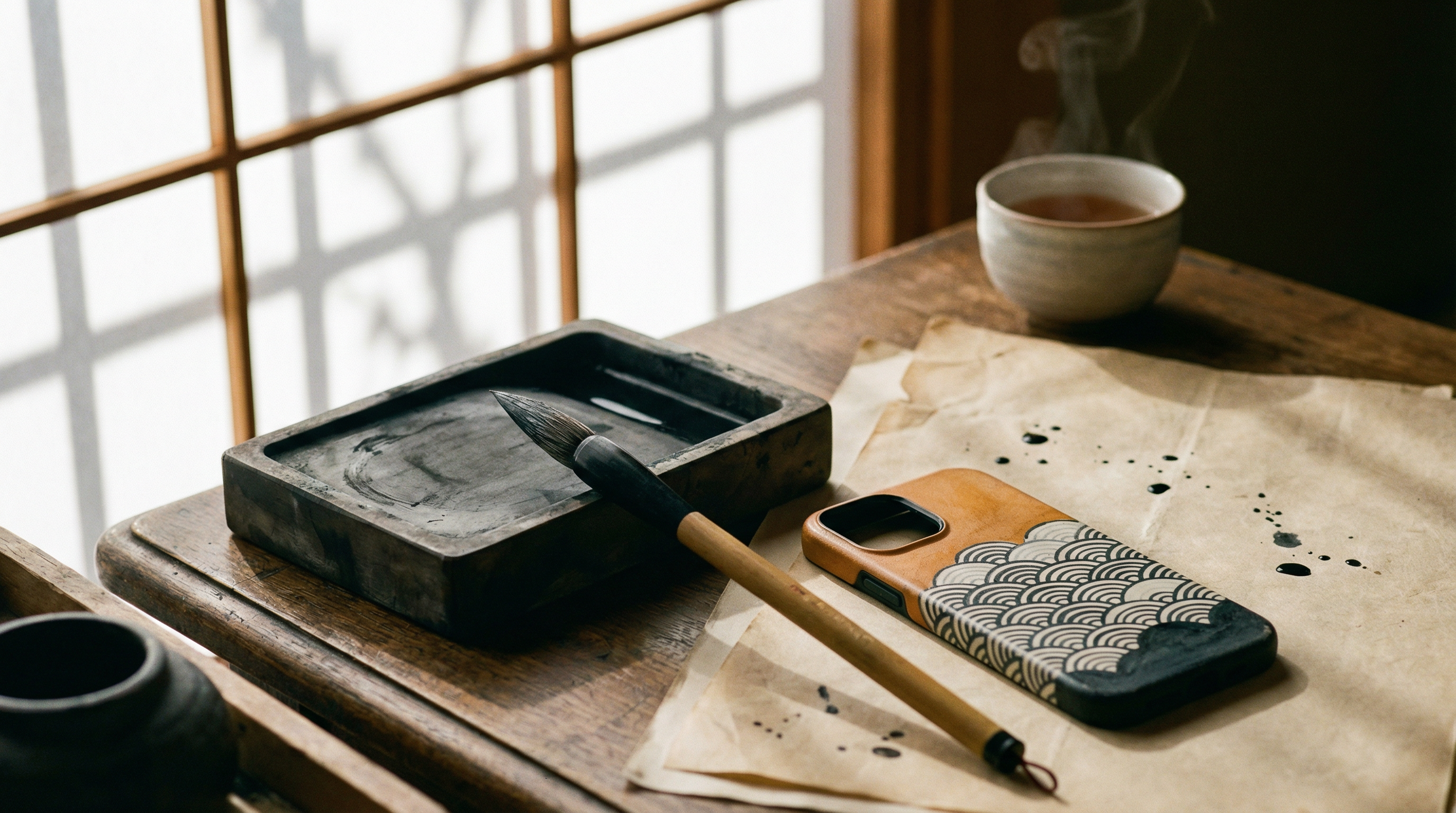
The brush stroke is the basic unit of Chinese visual expression. Its qualities — the pressure applied, the speed of movement, the angle of the brush, the wetness of the ink — all communicate meaning. A stroke that begins with a firm press and lifts to a fine point carries different energy than one that maintains even pressure throughout. The trained eye reads these qualities as naturally as the untrained eye reads facial expressions.
This calligraphic sensibility pervades all Chinese visual arts. Chinese ink painting uses the same brush and ink as calligraphy, and the two arts are considered inseparable — the great painter must first be a great calligrapher. The bamboo painted by the Song dynasty master Su Shi is beautiful not just as a representation of bamboo but as a sequence of brush strokes that embody the bamboo's character: upright, flexible, hollow at the center.
The concept of qi (气, vital energy or breath) is central to understanding what calligraphy and painting seek to achieve. A great work of art is said to have qiyun (气韵), "spirit resonance" — a quality of aliveness that makes the viewer feel the artist's vital energy still present in the work. This is why Chinese connoisseurs speak of paintings as "breathing" or "living" — the best works seem to pulse with the energy of their creation.
Nature as Teacher: The Landscape Tradition
Chinese aesthetics is fundamentally a philosophy of nature. The great landscape painting tradition — shanshui (山水, literally "mountains and water") — is not merely a genre of art but a spiritual practice, a way of understanding the human relationship to the natural world.
The Song dynasty painter Guo Xi, in his treatise The Lofty Message of Forests and Streams, described three types of distance in landscape painting: gaoyuan (high distance, looking up from the base of a mountain), shenyuan (deep distance, looking into the depths of a mountain range), and pingyuan (level distance, looking across a flat plain). Each type of distance creates a different emotional experience — the awe of height, the mystery of depth, the tranquility of the horizontal.
This taxonomy reveals something important about Chinese aesthetic experience: it is fundamentally about the relationship between the viewer and the landscape, about how different spatial arrangements create different inner states. The landscape painting is not a picture of a place; it is an invitation to a particular quality of attention.
The Chinese garden embodies this philosophy in three dimensions. Unlike the formal European garden, which imposes geometric order on nature, the Chinese garden seeks to create the feeling of nature — compressed, concentrated, made more intensely itself through careful arrangement. A scholar's garden in Suzhou might contain a mountain in miniature, a lake in a courtyard, a bamboo grove in a corner. The goal is not to represent nature accurately but to evoke its essential qualities: the sense of endless depth, the play of light and shadow, the sound of water.
The Scholar's Aesthetic: Wenren Culture
From the Song dynasty onward, Chinese aesthetics was increasingly shaped by the wenren (文人) tradition — the culture of the educated scholar-official class. The wenren aesthetic valued restraint over opulence, suggestion over statement, the personal over the official.
The scholar's studio — the zhai (斋) — was the physical embodiment of this aesthetic. It was furnished with objects chosen for their quality of gu (古, antiquity) and ya (雅, refinement): an ancient bronze vessel, a scholar's rock of unusual form, a few choice books, an inkstone of fine grain. The studio was not decorated but curated — each object chosen for its ability to cultivate the mind and nourish the spirit.
This aesthetic of cultivated simplicity — sometimes called qingtan (清淡, "clear and plain") — is one of Chinese culture's most enduring contributions to world aesthetics. It anticipates by centuries the Japanese concept of wabi-sabi, the Scandinavian ideal of lagom, the contemporary design principle of "less is more." But in the Chinese tradition, this simplicity is not minimalism for its own sake; it is simplicity as a form of depth, a clearing away of the superficial to reveal what is essential.
Living with Chinese Aesthetics Today
Chinese aesthetics is not a historical artifact. It is a living tradition, constantly reinterpreted by contemporary artists, designers, and makers who find in its principles a set of values urgently relevant to the present moment.
In an age of visual noise and relentless accumulation, the Chinese aesthetic of emptiness offers a different possibility: that beauty can be found in what is left out, that restraint is a form of generosity, that a single well-chosen object can speak more eloquently than a room full of things.
In an age of disposability and surface, the Chinese aesthetic of qi — of vital energy, of the artist's presence in the work — offers a reminder that the objects we surround ourselves with carry the energy of their making. A brush stroke made with full attention is different from one made carelessly, and the difference is perceptible even when we cannot name it.
At COOCOZY, we find in Chinese aesthetics not a style to be applied but a philosophy to be inhabited. The ink wash patterns, the mountain silhouettes, the scholar's rock forms that appear in our designs are not decorations; they are invitations to a particular quality of attention — to slowness, to depth, to the beauty that reveals itself only when you stop looking for it.
To carry a piece of this visual language with you is to carry a fragment of one of humanity's great aesthetic traditions. And in that fragment, if you look carefully, you will find the whole.
Your cart is empty
Add pieces to begin